THE PROBLEM
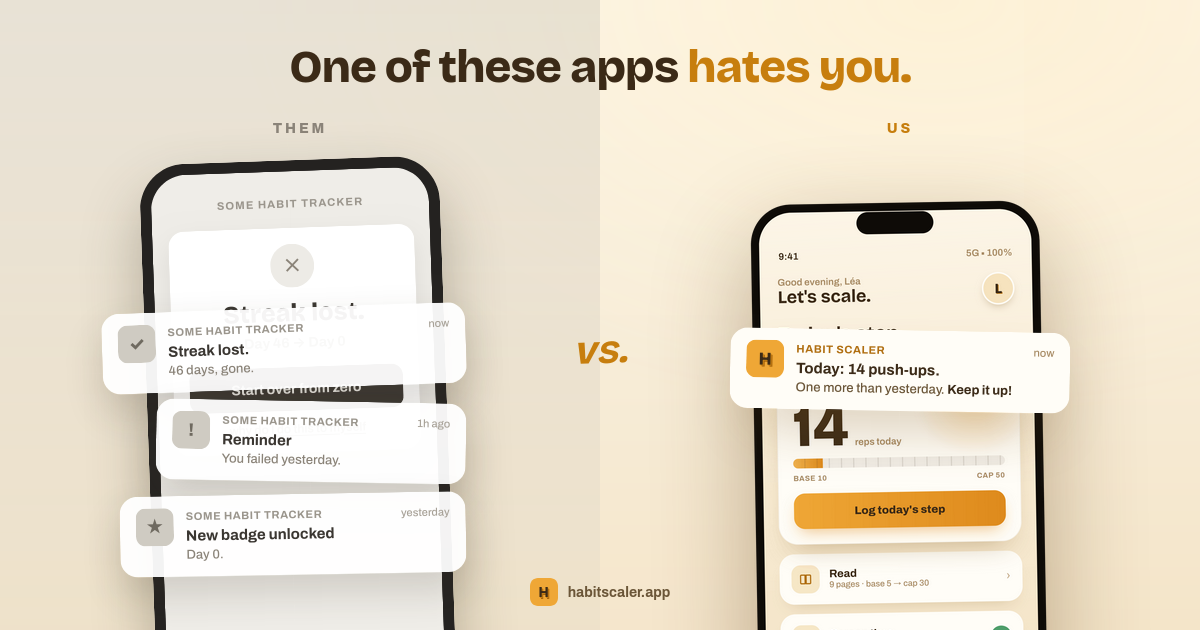
The habit tracker market is already full of apps that do roughly the same thing: you create a habit, check a box and try to keep your streak for as long as possible.
Personally, that system frustrates me. The point of a habit is to improve. Except we’re not robots. Sometimes we’re not in the mood, sometimes we hit a plateau, sometimes we miss a day. Why should the app penalize you for that? It’s just demotivating.
And if I want to go from 10 to 50 push-ups, checking “I did my push-ups” doesn’t tell me how many to do today or how to progress.
That’s where the idea for HabitScaler came from.
THE IDEA
Basically, you choose a habit, your starting point and the level you want to reach. The app then calculates your daily target and gradually adjusts it.
For example, you start with 10 push-ups and want to reach 50. The target increases a little at a time. Once you reach 50, you move into maintenance: the habit continues, it doesn’t disappear because you reached your goal.
If you miss one planned session, the target stays the same. If you miss two in a row, it drops slightly so you can get back to it. You don’t build up a debt of push-ups to make up the next day…
For bad habits, it works the other way around. You can reduce your screen time from 4h toward 1h30, for example, and see the time you get back over the days.
What interests me is seeing those small efforts add up over time. That’s the progress I wanted to put at the center of the app.
THE MVP
I started HabitScaler in early July 2026, right after putting TheoryCraft on pause.
This time, the scope was clear:
- create a habit
- choose a direction, scale up or scale down
- calculate today’s target
- handle missed days
- show compound progress
- ship a mobile app clean enough to test
That’s enough for a V1. After spending ten months on TheoryCraft, I really wanted to apply what I’d learned: focus on the MVP and cut everything else.
I built the app and opened testing in about 10 days. I use Flutter and Dart for the mobile app, and Elixir and Phoenix LiveView for the web.
Ten months for the first project, about ten days for this one. It took me ten years of development to start learning how to reduce scope, but well, we’re making progress :)
There was still some distance between an app ready to test and an app available in the stores, though.
THE SOCIAL PART
I also added shareable progress cards. You can announce your goal, show a milestone or share what you’ve done over the last 30 days.
For example, you can show that you went from 10 to 32 push-ups, or how many hours of screen time you got back. That feels more meaningful to me than a day counter.
Each card includes a link to the plan so someone else can use it. And yes, publicly announcing what you plan to do also makes quitting a bit more awkward. That’s intentional.
THE RELEASE
On July 9, 2026, I offered 12 free lifetime spots on X. Google was asking me for 12 testers for 14 days before I could publish with my individual account. I was starting from zero, so I had to find them somehow.
By July 11, the spots were filled. I ran the tests, then moved to a business account and discovered that this type of account let me skip that requirement…
At least 12 people got free lifetime access.
I submitted the app for Google review on July 29 and announced its public Android release on July 31. HabitScaler has been available on Google Play since then.
Anyway, building it took about ten days. Publishing it took weeks of paperwork.
AND IOS
For iOS, I first had to change my company’s legal structure so I could open the developer account with my company.
Then Apple took 22 days to verify my identity and company documents. I’d been waiting since July 28. The approval finally arrived on August 19, after an email asking why checking two documents was taking three weeks.
On August 25, I got back to the iOS version using an iPhone simulator on a Mac Mini VPS. That morning I’d given myself the day to finish, and by the evening the build had been submitted to Apple.
They rejected the app in less than a day. At least that part was fast…
Among other things, they wanted a video on a real iPhone showing onboarding, the features, notifications, the paywall, purchases and restore. I also had to detail the devices tested, the external services used and what each purchase unlocked.
By September 1, I’d had three rejections. In my latest update on September 6, the app was still under review. The company had been approved, but the app still hadn’t.
NOW WHAT
HabitScaler is available on Android. For iOS, I’m still waiting for Apple to approve the app.
What I already take away from it is that I managed to ship a small MVP after spending ten months on the previous one. And for my next mobile app, I’ll prepare the developer accounts and paperwork before the app is ready.
The build was quick this time. I just hadn’t expected to spend so much time trying to publish the app…